

White vs Green Phosphor
One of the most essential parts of an IIT is its phosphor screen. It is what you see and what converts the electrons back to photons.
Typically, the phosphor is deposited on the back of the fiber optic and then covered with a layer of aluminum. The aluminum layer reflects the light that would otherwise go back into the tube towards the viewer, which makes the screen brighter. It also carries away the electrical charge so it does not build up on the screen.
There is a multitude of phosphor types that are usually referred to with a P-number (e.g. P22). Four parameters are the most important ones for evaluating a phosphor screen’s performance and suitability: conversion factor, light spectrum, decay time and resolution.
The four parameters
Conversion factor
Refers to the conversion rate of electrons to photons, i.e. how many photons are emitted by one electron hitting the screen. A high conversion rate does not necessarily mean the eye will perceive a bright image, as that depends entirely on the wavelengths of the emitted light.
Light spectrum
The light spectrum the screen emits, e.g. 475 nm to 600 nm for P43.
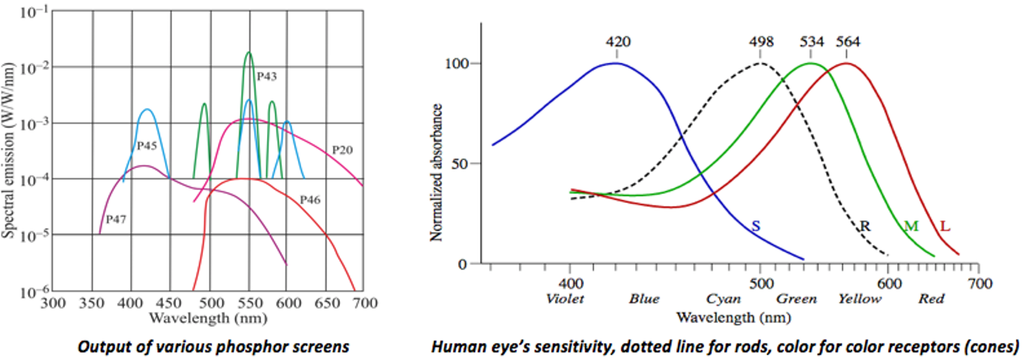
Decay time
The time the screen needs to go back to a low brightness after being activated. It has to be a lot shorter than the temporal inertia of the eye. Comparable to the refresh rate of a TV screen.
Resolution
Depends on the average size of the particles in the screen. Bigger particles would be more efficient but would eventually create a literally grainy image. Normally kept at about twice the resolution of the final system.
The different phosphors

P20 (very similar to P22) and P45 taken with a day cap (pinhole), P43 with a full daylight filter
P22 (green)
Pros:
- High luminous efficiency, almost the same as the human eye for the color green
- Less visible noise
- The human eye is most sensitive to contrast in green
- Very suitable for static observation
Cons:
- Long decay time (60 ms to 10%)
- Some users find the bright green image tiring over longer periods
P22 is mostly found in older tubes today.
P43 (yellow-green)
Pros:
- High luminous efficiency
- The human eye is most sensitive to contrast in green
- Short decay time (1.2 ms to 10%)
- More yellow-green image compared to P22 and less eye fatigue in comparison
- Much higher conversion rate and light emission compared to P45
Cons:
- Some users find green more tiring than white over longer periods
- Narrower spectrum, so the image is monochrome green
P45 (white)
Pros:
- Many users find the black and white image more natural and more comfortable for long use
- Short decay time (1.5 ms to 10%)
Cons:
- Lower luminous efficiency than P22/P43, which can give a darker perceived image
- Not every eyepiece is corrected for the wider spectrum of P45, which can cause slight chromatic aberration
Summary
There are strong arguments for both green and white phosphor and both have their upsides and downsides. Over the last years the market has moved clearly from green to white, first in the US and now in Europe too. White phosphor tubes are certified for aviation and many armies have made P45 their standard. Photonis, for example, makes its current tubes with either P43 or P45.

Green phosphor (left) and white phosphor (right) side by side
Studies so far have not shown a clear difference in visual performance between the two. How bright and comfortable the image feels differs from person to person and depends on the conditions, so you cannot say that P45 or P43 is better. Our recommendation is to try both in a comparable environment and decide afterwards.